Category Archives: Feast Days

The Idolatry of Not Taking Up Our Crosses: Homily for the Sunday After the Elevation of the Holy Cross and The Great Martyr Eustathios

SUNDAY AFTER HOLY CROSS, Mark 8: 34-38, 9:1

Galatians 2:16-20; Mark 8:34-9:1

Screen Shot 2021-09-19 at 10.24.42 amAs we continue to celebrate the Exaltation of the Holy Cross, we do something that would have made no sense to anyone at the time of our Lord’s ministry in first-century Palestine. The cross was then simply the most feared instrument of execution that the Roman Empire used to discourage anyone who thought of rebelling against the military occupation of their homeland. Our Lord’s disciples, along with the rest of the Jews, certainly did not expect a Messiah Who would suffer such a dishonourable fate. They wanted a new King David to liberate their land from the pagans and to bring power and glory to their nation. They wanted a deliverer to gain the whole world on their behalf, but who would have been unable to heal their souls. Continue reading

Comments Off on The Idolatry of Not Taking Up Our Crosses: Homily for the Sunday After the Elevation of the Holy Cross and The Great Martyr Eustathios

Filed under Feast Days, Readings, Sunday Homilies

The Nativity of the Most-Holy Theotokos (September 8)

Screen Shot 2021-09-05 at 9.26.06 amThe first Great Feast to fall in the Church Year is the Nativity of the Most-Holy Theotokos. It is entirely fitting that at the beginning of the new religious year all Orthodox Christians should come before the highest example of human holiness that the Orthodox Church holds precious and venerates that of Mary, the Theotokos and Mother of God. This day is seen as one of universal joy; for on this day the boundary of the Old and New Covenants was born the Most-Blessed Virgin, pre-arranged from the ages by Divine Providence to serve the mystical Incarnation of God the Word. Continue reading

Comments Off on The Nativity of the Most-Holy Theotokos (September 8)

Filed under Feast Days, Readings, Saints

Holy 40 Virgin-Martyrs and their Teacher the Hieromartyr Ammon the Deacon at Heraclea September 1

9bfc849e8617bcd6e8e8eaec9d070526

The Holy Forty Virgin Martyrs with their teacher, Deacon Ammoun were captured by Baudos the governor, and were tortured because they would not offer sacrifice to idols. The holy martyrs endured many cruel torments, which were intended to force them to renounce Christ and worship idols. Later, they were sent to Heraclea in Thrace to appear before the tyrant Licinius. The valiant martyrs remained unshakeable, however. Saint Ammoun and eight of the virgins were beheaded, ten virgins were burned, six of them died after heated metal balls were put into their mouths, six were stabbed with knives, and the rest were struck in the mouth and stabbed in the heart with swords.

Holy 40 virgin-martyrs and their teacher the Hieromartyr Ammon the Deacon at Heraclea in Thrace: Adamantine, Athena, Akrive, Antigone, Arivea, Aspasia, Aphrodite, Dione, Dodone, Elpinike, Erasmia, Erato, Ermeneia, Evterpe, Thaleia, Theanoe, Theano, Theonymphe, Theophane, Kalliroe, Kalliste, Kleio, Kleonike, Kleopatra, Koralia, Lambro, Margarita, Marianthe, Melpomene, Moscho, Ourania, Pandora, Penelope, Polymnia, Polynike, Sapfo, Terpsichore, Troada, Haido, and Harikleia.

Comments Off on Holy 40 Virgin-Martyrs and their Teacher the Hieromartyr Ammon the Deacon at Heraclea September 1

Filed under Feast Days, Readings, Saints

Apodosis of The Dormition of the Most Holy Theotokos commemorating Panagia tou Harou whose icon is enthroned at our Parish

Screen Shot 2021-08-22 at 9.12.53 am

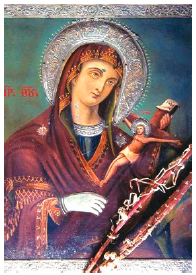
Panagia tou Harou is the name of the unique icon which depicts the Virgin Mary cradling the crucified Christ, rather than the Christ child, hence its name (haros in Greek means “death”). This icon is found in the church of St. John the Theologian, Leipsoi (Greece). The annual commemoration of the icon takes place on August 23 when the island of Leipsoi fills with pilgrims from all over the Dodecanese, to witness the procession of the icon around the entire island and see the annual blossoming of the dead bouquet of lilies on the icon.

In the 1940s, a lady was praying to the “Panagia tou Harou” icon. Her prayers were answered, and in gratitude placed a simple bouquet of lilies on the icon. These lilies withered but remained on the icon. In the following year, at the leave-taking of the feast of the Dormition (August 23), these lilies blossomed again and gave off a fragrance. Since then, this miracle occurs annually on the day of the feast.

Comments Off on Apodosis of The Dormition of the Most Holy Theotokos commemorating Panagia tou Harou whose icon is enthroned at our Parish

Filed under Feast Days, Stories of Faith

“A Great Sign” Rev 12:1: A Homily on the Dormition of the Theotokos

Today we celebrate a great and joyous solemnity: the falling asleep of the Mother of God in Jerusalem, and her bodily translation into glory.

“The Whole Mystery of the Economy”

The readings from Genesis, Ezekiel, and Proverbs present us with a series of images, all with reference to the Theotokos. She is the ladder ascending from earth to heaven, beheld by the patriarch Jacob in a vision (Gen. 28:12). She is Bethel, God’s house, and the gate of heaven (Gen. 28:17). She is the east gate of the Temple sanctuary, which remains shut – virginal: no man enters, “for the Lord, the God of Israel, has entered through it,” as Ezekial prophesies (Ez. 44:2). She is wisdom, or the house of wisdom, of which king Solomon speaks (Prov. 9:1) Continue reading

Comments Off on “A Great Sign” Rev 12:1: A Homily on the Dormition of the Theotokos

Filed under Feast Days, Readings, Sunday Homilies

A Woman clothed with the Sun

At the end of his life, in exile on the island of Patmos, the Apostle John had a vision. “A great sign appeared in heaven: a woman clothed with the sun, with the moon under her feet and a crown of twelve stars on her head” (Rev. 12:1). Most commentators take this image from the book of Apocalypse to be referring to the Church, or the remnant Israel. Some, however, see here an image of Mary, especially as she is the daughter of Zion, and she typifies the Church. Some even see an image of her bodily assumption. Continue reading

Comments Off on A Woman clothed with the Sun

Filed under Feast Days, Readings

THE TRANSFIGURATION OF OUR LORD MATTHEW 17:1-9

And after six days Jesus took Peter, James, and John his brother, brought them up on a high mountain by themselves, and was transfigured before them. His face shone like the sun, and His clothes became as white as the light. And behold, Moses and Elijah appeared to them, talking with Him. Then Peter answered and said to Jesus, “Lord, it is good for us to be here; if You wish, let us make here three tabernacles; one for You, one for Moses, and one for Elijah.” While he was still speaking, behold, a bright cloud overshadowed them; and suddenly a voice came out of the cloud, saying, “This is My beloved Son, in whom I am well-pleased, Hear Him!” And when the disciples heard it, they fell on their faces and were greatly afraid. And Jesus came and touched them and said, “Arise, and do not be afraid.” And when they had lifted up their eves, they saw no one but Jesus only. And as they came down from the mountain, Jesus commanded them, saying, “Tell the vision to no one until the Son of Man is risen from the dead.”

“You were transfigured on Mt. Tabor showing the exchange mortal humans will make with your glory at your second and fearful coming O Saviour! (Matins)

Continue reading

Comments Off on THE TRANSFIGURATION OF OUR LORD MATTHEW 17:1-9

Filed under Feast Days, Readings

The Ascension of Our Lord Jesus Christ

Jesus did not live with his disciples after his resurrection as he had before his death. Filled with the glory of his divinity, he appeared at different times and places to his people, assuring them that it was he, truly alive in his risen and glorified body.

To them he presented himself alive after his passion by many proofs, appearing to them during forty days, and speaking of the Kingdom of God (Acts 1:3). Continue reading

Comments Off on The Ascension of Our Lord Jesus Christ

Filed under Feast Days, Readings

The humility and piety of St Porphyrios of Kavsokalyvia

On December 2 the holy Orthodox Church commemorates the recently-glorified God-bearing elder of our times, St. Porphyrios of Kavsokalyiva, who reposed on this day in 1991. He was known as a humble ascetic with the gift of foresight who always served the Divine Liturgy with compunction. In his memory we offer below his final letter, as well as an audio recording of his heartfelt serving of the Divine Liturgy.

While at the Holy Skete of Kavsokalyvia on Mt. Athos, the Elder Porphyrios had given orders for his grave to be dug. Through a spiritual child of his, he dictated a farewell letter of advice and forgiveness to all his spiritual children.

Here is the letter as it was sent to the site Orthodox Outlet for Dogmatic Enquiries from the Holy Convent of the Transfiguration of the Saviour. It was found amongst the monk’s garments that were laid out for his burial on the day of his departure. This letter is a profound example of the humility of the saints who have acquired the likeness of God through their humble ascetic offerings.

My dear spiritual Children,
Now that I am still in charge of my faculties, I want to give you some advice.
Ever since I was a child, I was always in sin. When my mother sent me to watch the animals on the mountain, (my father had gone to America to work on the Panama Canal for us his children, because we were poor), there, where I shepherded the animals, I slowly read, word by word, the life of St. John the Hut-dweller and I loved St. John very much. I said a lot of prayers, like the young child that I was, twelve or fifteen years old, I don’t remember too well. I wanted to follow his example. So, with a lot of difficulty, I secretly left my parents and came to Kavsokalyvia on the Holy Mountain. I became obedient to two elders, the true brothers, Panteleimon and loannikios.
They happened to be very devout and full of virtue, I loved them very much and because of that, with their blessing, I gave them absolute obedience. That helped me a lot. I also felt great love for God and got along very well. However, because of my sins, God allowed me to become ill, and my elders told me to go to my parents in my village of St. John, Evia. Although I had sinned a lot from when I was a small child, when I returned to the world I continued to commit sins which, today are very many. The world, however, thought highly of me, and everyone shouts that I’m a saint.
I however, feel that I am the most sinful person in the world. Of course, whatever I remembered I confessed, and I know God has forgiven me. But now I have the feeling that my spiritual sins are very many and I ask all those who have known me to pray for me, because, for as long as I lived, I humbly prayed for you, too. Now that I’m leaving for heaven, I have the feeling that God will say to me, “What are you doing here?” I have only one thing to say to him, “I am not worthy of here, Lord, but whatever your love wills, it’ll do for me.” From then on, I don’t know what will happen. I however, wish for God’s love to act.
I always pray that my spiritual children will love God, Who is everything, so that He will make us worthy to enter His earthly uncreated Church. We must begin from here. I always made the effort to pray, to read the hymns of the Church, the Holy Scriptures and the Lives of the Saints. May you do the same. I tried, by the grace of God, to approach God and may you also do the same.
I beg all of you to forgive me for whatever I did to upset you.

Hieromonk Porphyrios
Kavsokalyvia, June 4/17 1991

Comments Off on The humility and piety of St Porphyrios of Kavsokalyvia

Filed under Feast Days, Readings, Saints

The Feast of our Holy Father Sava the Sanctified

Celebrated on 5 December

The unknown village of Mutalaska, in the Province of Cappadocia, became famous through this great light of the Orthodox Church, for Saint Sava was born there. He left the home of his parents, John and Sophia, at the age of eight and became a monk in a nearby Monastery called “Flavian’s.”

After ten years, he moved to the Monasteries of Palestine, staying longest in the Monastery of Saint Euthymius the Great (January 20th) and Theoctistus. Euthymius, who had the gift of discernment, foretold that he would be a famous monk and leader of monks, and that he would found a Monastery that would be greater than any other of that day. After Saint Euthymius’s death, Sava went into the desert, where he lived for five years as a hermit in a cave which an Angel of God showed him. After that, when he had become a perfect monk, he began by divine Providence to gather round him many desirous of the spiritual life. They very quickly grew in number, so that Sava had to build both a church and many cells. Some Armenians also came to him, and he set aside a cave for them, and they celebrated the services there in their own language. When his father died, his aged mother Sophia came to him and he made her a nun and gave her a cell away from the Monastery, where she lived in asceticism till her death.

This Holy Father endured many attacks from those close to him, from heretics and from demons. But he overcame them all in these ways: those close to him he won over by his goodness and forbearance, the heretics by an unshakeable confession of the Orthodox faith, and the demons with the sign of the Cross and the invocation of God’s aid. He had a particularly severe battle with the demons on the mountain of Castellium, where he founded the second of his seven Monasteries. He and his neighbour, Theodosius the Great, are considered to be the greatest lights and pillars of Orthodoxy in the East, kings and Patriarchs were brought to the right Faith by them, and these holy and wonderful men, strong in the power of God, served each and every man as an example of humility. Saint Sava entered into rest in 532 A.D. at the age of 94, after a life of great labour and great reward. Among all his other great and good works, let this be remembered above all: that he compiled the first Order of Service for use in Monasteries, now known as the Jerusalem Typikon.

Comments Off on The Feast of our Holy Father Sava the Sanctified

Filed under Feast Days, Readings, Saints