
 The first Great Feast to fall in the Church Year is the Nativity of the Most-Holy Theotokos. It is entirely fitting that at the beginning of the new religious year all Orthodox Christians should come before the highest example of human holiness that the Orthodox Church holds precious and venerates that of Mary, the Theotokos and Mother of God. This day is seen as one of universal joy; for on this day the boundary of the Old and New Covenants was born the Most-Blessed Virgin, pre-arranged from the ages by Divine Providence to serve the mystical Incarnation of God the Word. Continue reading
The Nativity of the Most-Holy Theotokos (September 8)
Comments Off on The Nativity of the Most-Holy Theotokos (September 8)
Filed under Feast Days, Readings, Saints
Forgiveness and the Healing of the Soul: Homily for the 11th Sunday of Matthew in the Orthodox Church
Sometimes the truth has to come to us in an unusual way in order to get our attention. That is because most of us are really good at hearing only what we want to hear and seeing only what we want to see. Unfortunately, that means we are skilled in ignoring uncomfortable truths, including the simple teaching of our Lord that we must forgive others if we want God to forgive us. In today’s gospel text, Jesus Christ spoke a very disturbing parable that should make that truth clear to us all. Continue reading
Comments Off on Forgiveness and the Healing of the Soul: Homily for the 11th Sunday of Matthew in the Orthodox Church
Filed under Readings, Sunday Homilies
Holy 40 Virgin-Martyrs and their Teacher the Hieromartyr Ammon the Deacon at Heraclea September 1

The Holy Forty Virgin Martyrs with their teacher, Deacon Ammoun were captured by Baudos the governor, and were tortured because they would not offer sacrifice to idols. The holy martyrs endured many cruel torments, which were intended to force them to renounce Christ and worship idols. Later, they were sent to Heraclea in Thrace to appear before the tyrant Licinius. The valiant martyrs remained unshakeable, however. Saint Ammoun and eight of the virgins were beheaded, ten virgins were burned, six of them died after heated metal balls were put into their mouths, six were stabbed with knives, and the rest were struck in the mouth and stabbed in the heart with swords.
Holy 40 virgin-martyrs and their teacher the Hieromartyr Ammon the Deacon at Heraclea in Thrace: Adamantine, Athena, Akrive, Antigone, Arivea, Aspasia, Aphrodite, Dione, Dodone, Elpinike, Erasmia, Erato, Ermeneia, Evterpe, Thaleia, Theanoe, Theano, Theonymphe, Theophane, Kalliroe, Kalliste, Kleio, Kleonike, Kleopatra, Koralia, Lambro, Margarita, Marianthe, Melpomene, Moscho, Ourania, Pandora, Penelope, Polymnia, Polynike, Sapfo, Terpsichore, Troada, Haido, and Harikleia.
Comments Off on Holy 40 Virgin-Martyrs and their Teacher the Hieromartyr Ammon the Deacon at Heraclea September 1
Filed under Feast Days, Readings, Saints
Men-pleasing and Murder: A Homily for the Beheading of the Forerunner
BEHEADING OF THE FORERUNNER, ST JOHN THE BAPTIST, Mark 6: 14-30
The memory of the righteous is praised, says King Solomon (Proverbs 10:7 LXX); but the Lord’s testimony suffices the righteous one we remember today. What testimony? Among them that are born of women, there hath not risen a greater than John the Baptist (Matthew 11:11). What honour can our praises add to one who boasts such an eminent witness? How can the life that today is crowned with a glorious death be fittingly honoured? The life of St. John the Baptist towers so far above the life of ordinary, mortal men as to rival that of the angels. Indeed, the Prophet Malachi calls him such when he speaks of him, saying, Behold, I send my messenger—that is, αγγελος, angel—before thy face, which shall prepare thy way before thee(Malachi 3:1, Mark 1:2).
Comments Off on Men-pleasing and Murder: A Homily for the Beheading of the Forerunner
Filed under Readings, Saints, Sunday Homilies
How to Avoid Sinking: Homily for the 9th Sunday of Matthew in the Orthodox Church – Corinthians 3:9-17; Matthew 14:22-34
Sometimes we fall into the trap of thinking that we are totally self-sufficient and able to live exactly as we please with no serious consequences. Self-reliance, independence, and freedom certainly have their places, but they also have their limits and must be kept in proper perspective. We must develop these qualities in light of who we are before God, if we are to flourish as His beloved sons and daughters. Continue reading
Comments Off on How to Avoid Sinking: Homily for the 9th Sunday of Matthew in the Orthodox Church – Corinthians 3:9-17; Matthew 14:22-34
Filed under Readings, Sunday Homilies
Apodosis of The Dormition of the Most Holy Theotokos commemorating Panagia tou Harou whose icon is enthroned at our Parish
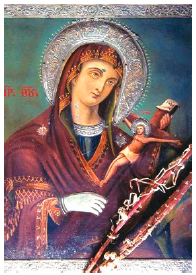
Panagia tou Harou is the name of the unique icon which depicts the Virgin Mary cradling the crucified Christ, rather than the Christ child, hence its name (haros in Greek means “death”). This icon is found in the church of St. John the Theologian, Leipsoi (Greece). The annual commemoration of the icon takes place on August 23 when the island of Leipsoi fills with pilgrims from all over the Dodecanese, to witness the procession of the icon around the entire island and see the annual blossoming of the dead bouquet of lilies on the icon.
In the 1940s, a lady was praying to the “Panagia tou Harou” icon. Her prayers were answered, and in gratitude placed a simple bouquet of lilies on the icon. These lilies withered but remained on the icon. In the following year, at the leave-taking of the feast of the Dormition (August 23), these lilies blossomed again and gave off a fragrance. Since then, this miracle occurs annually on the day of the feast.
Comments Off on Apodosis of The Dormition of the Most Holy Theotokos commemorating Panagia tou Harou whose icon is enthroned at our Parish
Filed under Feast Days, Stories of Faith
Weekly Program – 15 August DORMITION OF THE THEOTOKOS
THE FALLING ASLEEP OF THE THEOTOKOS
This great feast honours the Virgin Mary through whom the mystery of the Incarnation took place. As our Lord’s Mother, we seek her intercession to her Son for our every need. She listens, comforts, and prays for us. This is evident by the many miracles that are performed by her; the countless number of churches that are built in her honour. Continue reading
Comments Off on Weekly Program – 15 August DORMITION OF THE THEOTOKOS
Filed under Weekly Program
“A Great Sign” Rev 12:1: A Homily on the Dormition of the Theotokos
Today we celebrate a great and joyous solemnity: the falling asleep of the Mother of God in Jerusalem, and her bodily translation into glory.
“The Whole Mystery of the Economy”
The readings from Genesis, Ezekiel, and Proverbs present us with a series of images, all with reference to the Theotokos. She is the ladder ascending from earth to heaven, beheld by the patriarch Jacob in a vision (Gen. 28:12). She is Bethel, God’s house, and the gate of heaven (Gen. 28:17). She is the east gate of the Temple sanctuary, which remains shut – virginal: no man enters, “for the Lord, the God of Israel, has entered through it,” as Ezekial prophesies (Ez. 44:2). She is wisdom, or the house of wisdom, of which king Solomon speaks (Prov. 9:1) Continue reading
Comments Off on “A Great Sign” Rev 12:1: A Homily on the Dormition of the Theotokos
Filed under Feast Days, Readings, Sunday Homilies
A Woman clothed with the Sun
At the end of his life, in exile on the island of Patmos, the Apostle John had a vision. “A great sign appeared in heaven: a woman clothed with the sun, with the moon under her feet and a crown of twelve stars on her head” (Rev. 12:1). Most commentators take this image from the book of Apocalypse to be referring to the Church, or the remnant Israel. Some, however, see here an image of Mary, especially as she is the daughter of Zion, and she typifies the Church. Some even see an image of her bodily assumption. Continue reading
Comments Off on A Woman clothed with the Sun
Filed under Feast Days, Readings
The Earliest Known Prayer to the Theotokos
 The earliest known prayer to the Theotokos (Greek, Θεοτοκος, meaning “Bearer of God”) is a prayer found on a fragment of papyrus dating back to approximately AD 250. In 1917, the John Rylands Library (1) in Manchester, England, acquired a large panel of Egyptian papyrus. The prayer is located on the fragment recorded as reference number Greek Papyrus 470. The prayer appears to be from a Coptic Christmas liturgy or vespers written in Koine Greek although the fragment in question may be a private copy of the prayer. centuries before the Nestorian heresy. Continue reading


 St Vasilios Greek Orthodox Church